
Key Takeaways
The Triad of Clarity
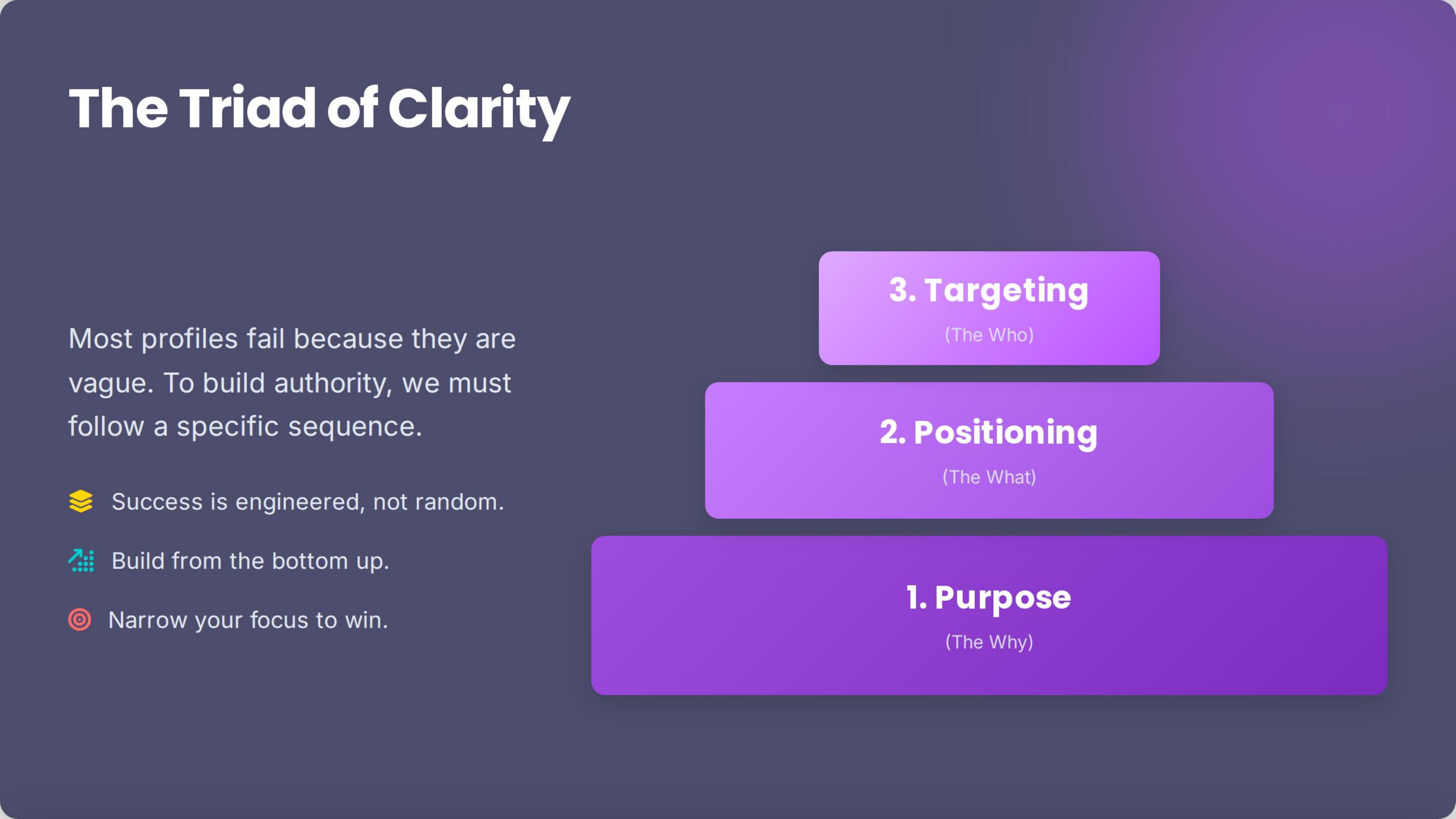
Most profiles fail because they are vague. They list skills ("Marketing," "Sales," "Java") but fail to offer a solution. To build authority, we use a specific sequence:
1. Purpose 2. Positioning 3. Targeting
Step 1: Purpose (Your "Why")
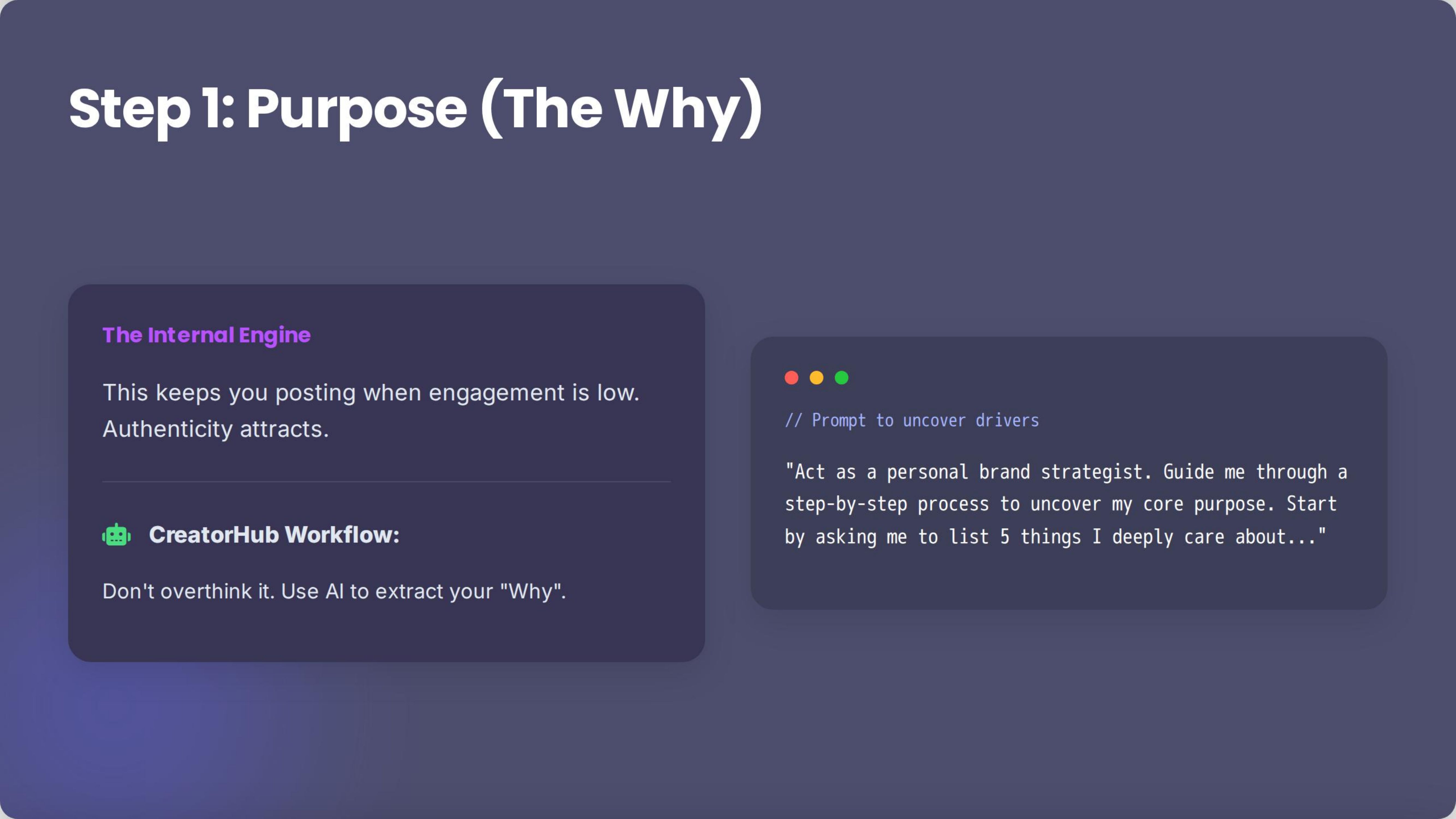
This is your internal engine. It's what keeps you posting when the engagement is low. It's not just about money; it's about what you care about. Authenticity attracts.
How to find it:
You don't need to meditate for a month. You can use AI to extract it.
🤖 CreatorHub Workflow:
Open AI Post Creation (or your preferred AI chat interface) and use this specific prompt to uncover your drivers:
"Act as a personal brand strategist. Guide me through a step-by-step process to uncover my core purpose. Start by asking me to list 5 things I deeply care about and why they matter to me on a personal level. Then, help me connect these to a professional mission."
Step 2: Positioning (Your "What")
Positioning answers the question: *"What box do I put you in?"*
People need to categorize you quickly. You cannot be "The guy who does marketing, loves dogs, and sometimes codes." You must own a specific vertical.
The "I Help" Formula
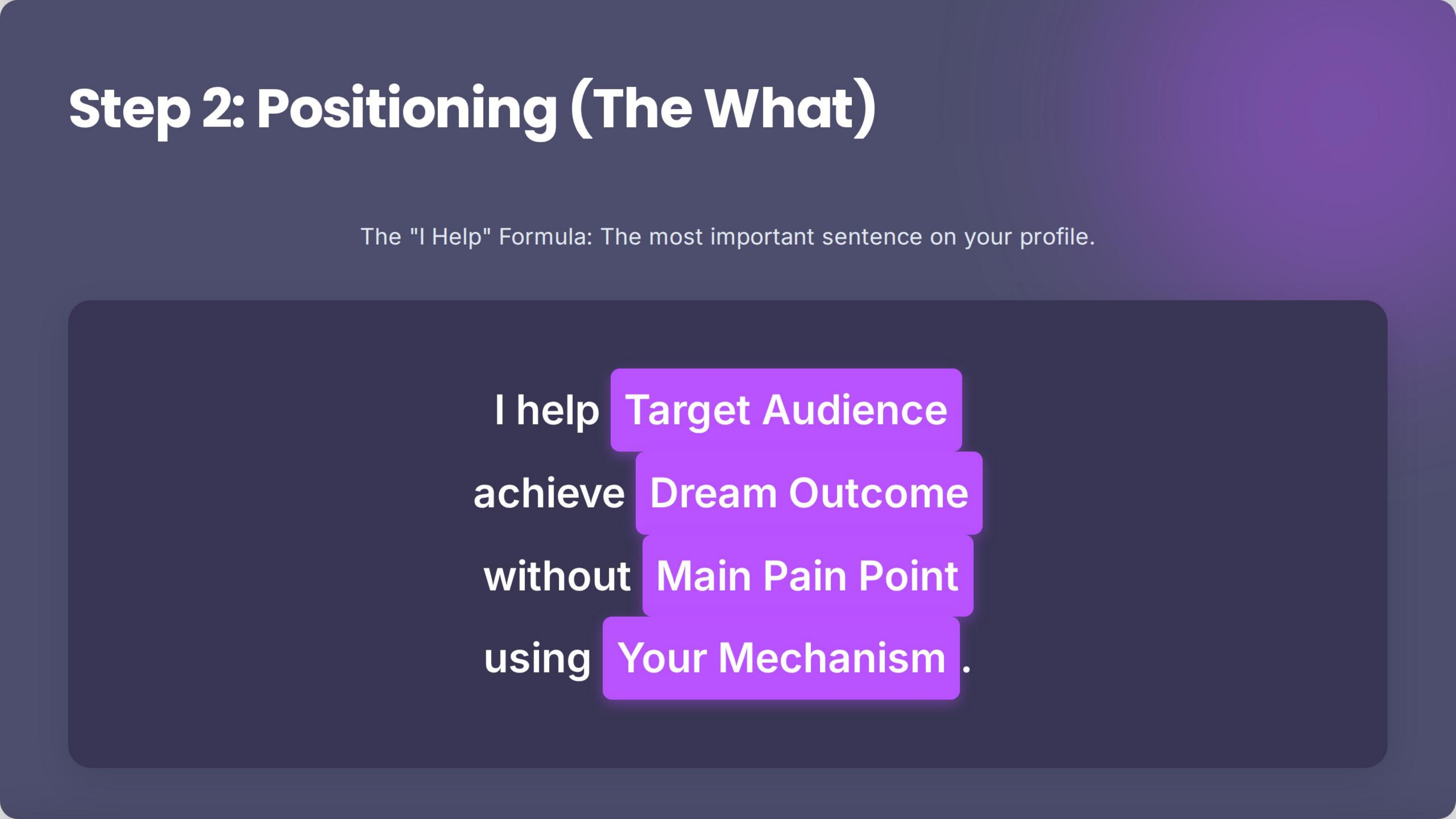
This is the single most important sentence on your profile.
"I help [Target Audience] achieve [Dream Outcome] without [Main Pain Point] using [Your Mechanism]."
- Target Audience: Be specific (e.g., "SaaS Founders" > "Business Owners").
- Dream Outcome: What they *really* want (e.g., "add $50k MRR" > "grow their business").
- Mechanism: Your unique method (e.g., "The Authority OS" > "Consulting").
Step 3: Targeting (Your "Who" / ICP)
This is your **Ideal Client Profile (ICP)**.
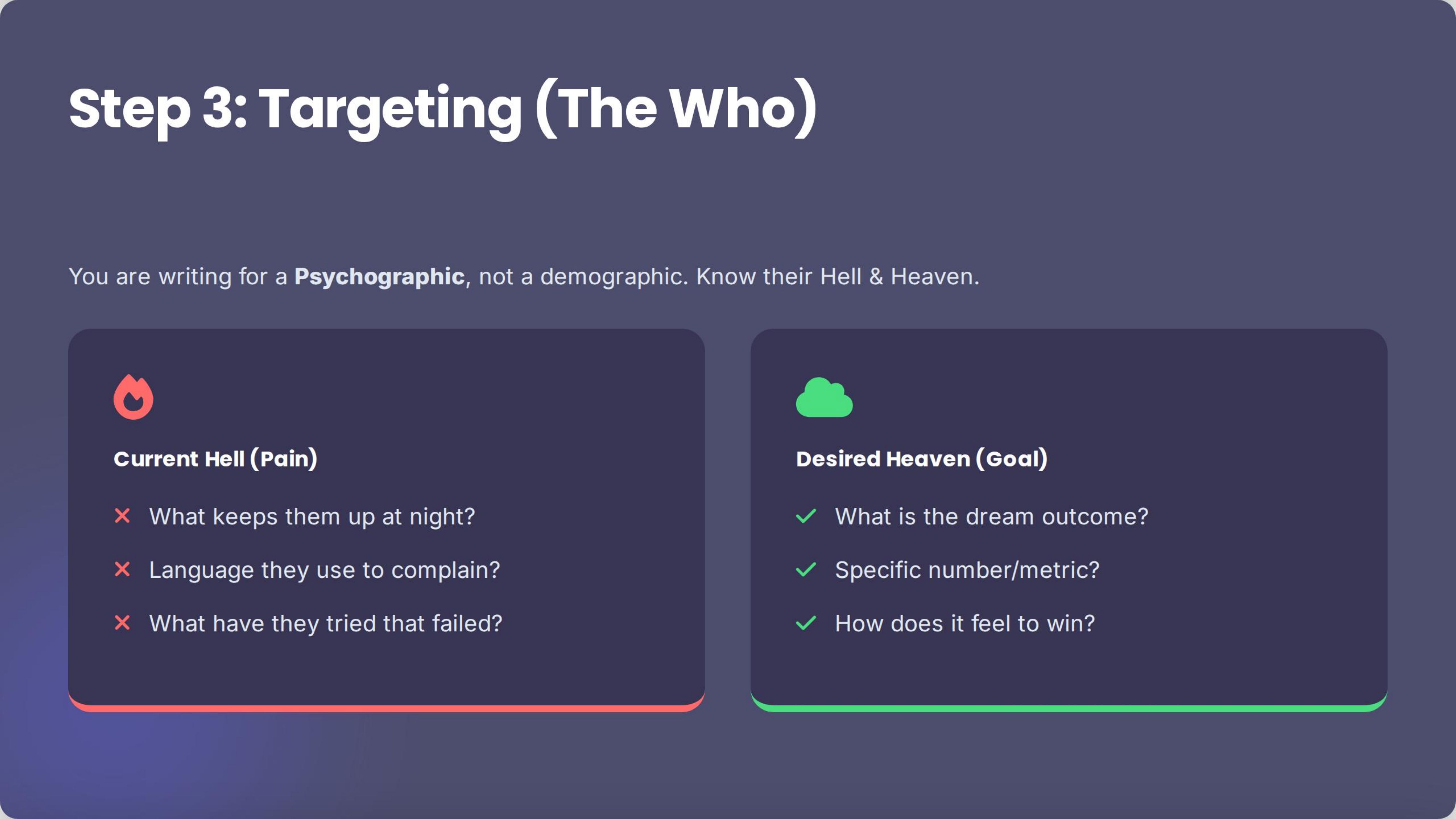
You are not writing for a demographic (e.g., "Men, 35-50, USA"). You are writing for a **Psychographic**.
You need to know the "One Person" you are talking to.
- What keeps them up at night?
- What is the specific language they use to describe their pain?
- What have they tried before that failed?
The Power of Exclusion:
Good targeting repels the wrong people just as strongly as it attracts the right ones. If your content annoys people who want "cheap, fast fixes," you are doing it right.
🤖 CreatorHub Workflow:
Use the **People Analytics (Spy)** or AI Chat feature to flesh out your ICP.
- Prompt: "My target audience is [Job Title] in [Industry]. List their top 5 waking-nightmare problems, their top 3 desires, and the specific jargon they use in their daily work."
Examples: The Formula in Practice
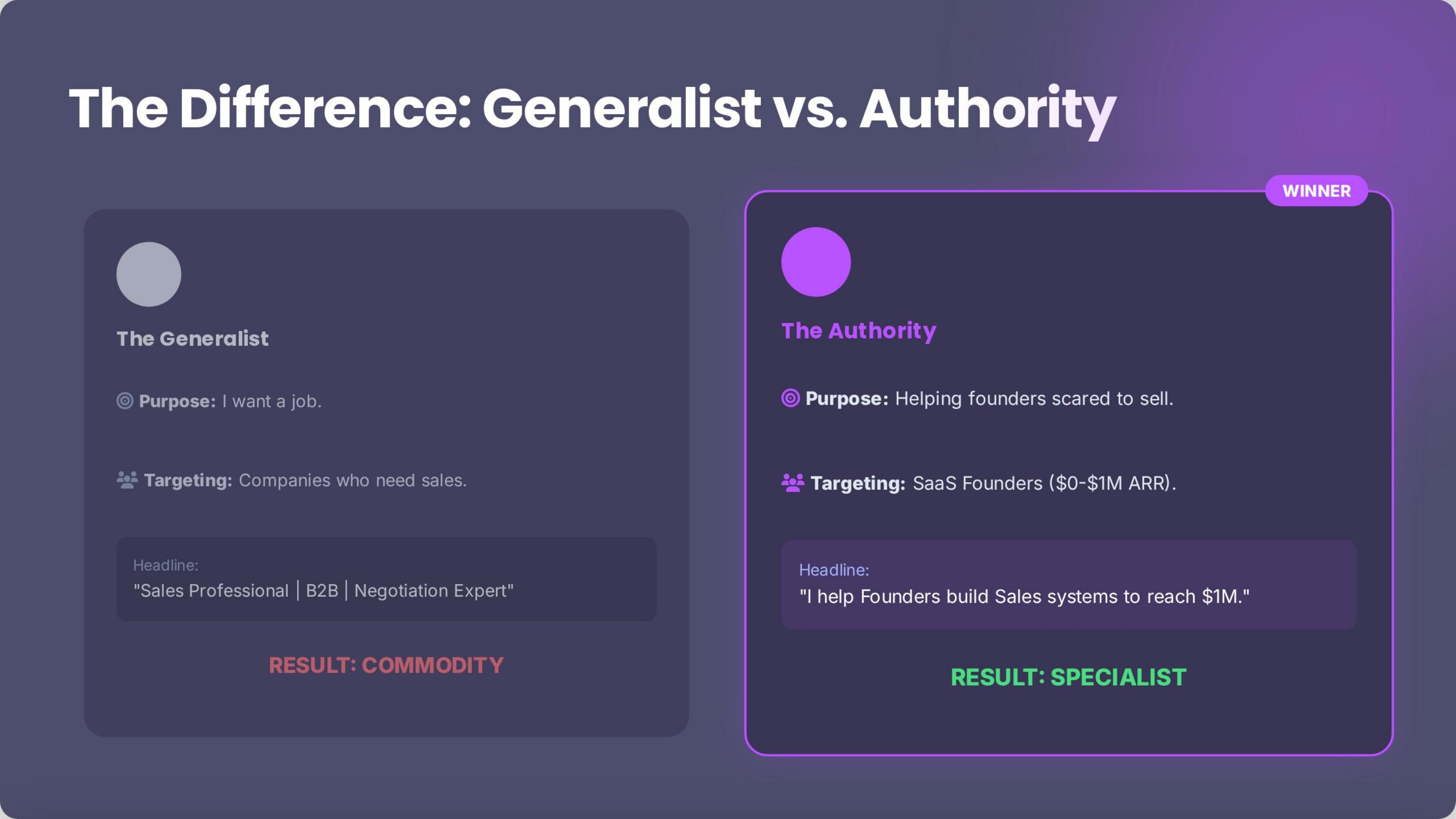
Example A: The Generalist (Weak)
- Purpose: I want a job.
- Targeting: Companies who need sales.
- Positioning: "Sales Professional | B2B | Negotiation Expert."
- Result: Commodity. Competes on price.
Example B: The Authority (Strong)
- Purpose: I hate seeing good products fail because founders are scared to sell.
- Targeting: Early-stage B2B SaaS Founders ($0-$1M ARR).
- Positioning: "I help **B2B Founders** build **Founders-Led Sales systems** to reach **$1M ARR** without **hiring expensive VPs**."
- Result: Specialist. Competes on value.
Actionable Steps (Homework)
Draft Your "I Help" Statement
Fill in the blanks: I help [Target Audience] achieve [Dream Outcome] without [Main Pain Point] using [Your Mechanism]. Tip: Be specific. "Marketing Managers" is better than "Professionals."
Define Your ICP's "Hell & Heaven"
- Write down 3 bullet points describing their current "Hell" (Pain).
- Write down 3 bullet points describing their "Heaven" (Desired Outcome).
- Note:
- This will become the source material for all your content in Module 3.
Refine with CreatorHub
- Highlight your draft "I Help" statement in the editor.
- Use Magic Commands:
- "Make it punchier and more authoritative."
Next Lesson: Now that we know *who* you are and *who* you help, we will turn your LinkedIn Profile into a high-converting Landing Page (Headline, Banner, and Bio) in Lesson 1.3.